[caption id=“attachment_10529” align=“alignnone” width=“315”]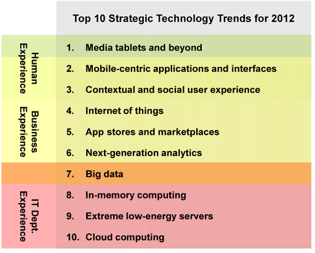 The top ten strategic trends for 2012[/caption]
Gartner’s 2012 article on the “Top 10 Technology Trends for 2012" shows an increasing importance placed on mobile-centric applications and interfaces and on development for media tablets and beyond. Source: Gartner (February 2012) With a forecasted worldwide media tablet sales of 118.9 million units in 2012, developers are leveraging on the various open source, cross platform web frameworks to rapidly develop and deploy mobile applications to cater to the market demand.
[caption id=“attachment_10530” align=“alignnone” width=“307”]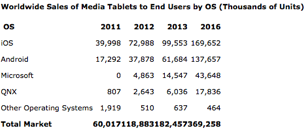 Worldwide sales of media tablets[/caption]
Source: Gartner (April 2012)
Let’s take a look at some of these frameworks and what they can offer: 1. Apache Cordova

- http://phonegap.com/
- Formerly known as PhoneGap.
- Supports native mobile application development using HTML, CSS, and Javascript.
- Supports a wide variety of mobile platforms including Windows Phone, Android, Bada, Blackberry iOS, Mac OS X, and WebOS.

- http://jquerymobile.com/
- Mobile version of JQuery.
- Provides a unified look and feel across mobile platforms including Windows Phone, Android, iOS, and Blackberry.
- Supports touch, mouse, and keyboard events.
- Uses HTML5 data attributes for configuration.
- Typically used in conjunction with Apache Cordova (PhoneGap).
3. Sencha Touch

- http://www.sencha.com/products/touch/
- Supports HTML5 mobile application development across mobile platforms including Android, iOS, and Blackberry.
- Provides a wide range of UI styles and themes.
- Supports touch events.
- Provides a custom API for mobile HTML5 interactive charts (Sencha Touch Charts).
- http://www.appcelerator.com/platform/titanium-sdk
- Supports native mobile application development using HTML, CSS, and Javascript.
- Supports Android and iOS mobile platforms.
- Provides its own marketplace for mobile applications.

- http://dojotoolkit.org/
- Provides unified Javascript toolkit for web and mobile development.
- Supports Android, iOS, and Blackberry mobile platforms.
- Provides rich UI widgets such as calendars, charts, and carousels.
- Built to be light weight for fast and efficient performance.

- http://www.zkoss.org/
- Provides Java web framework for mobile development using HTML, JQuery, and CSS.
- Server-centric framework that uses a proprietary markup language, ZUML.
- Provides pluggable components with enterprise security.
- Supports Java Mobile and Android mobile platforms.
- Provides UI components such as calendars, pivot tables, and spreadsheets.
Besides the frameworks mentioned above, you might also want to explore these Javascript frameworks and libraries for web and mobile development:
- Zepto (http://zeptojs.com/)
- Modernizer (http://modernizr.com/)
- CreateJS (http://createjs.com/)
- MooTools (http://mootools.net/)
- YUI (http://yuilibrary.com/)
With so many frameworks to choose from, you are on your way to building your very own millionaire dollar mobile application that is enjoyed by billions around the world.
Used any of these frameworks before? Which one works best for you? Do share with us your experiences in the comments below!