Intel Presents Invent50: An Engineering Competition for Students

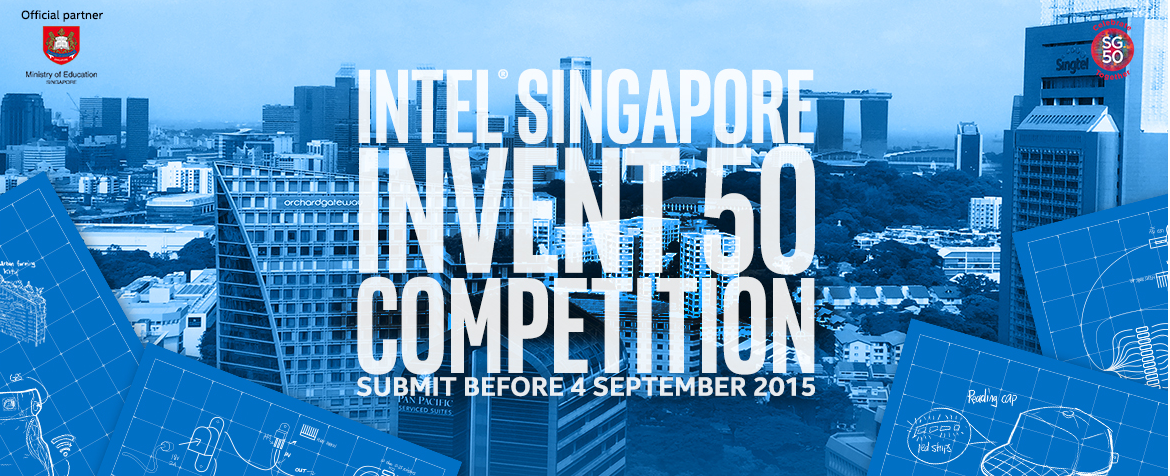
It definitely wouldn’t be news to hear that Singapore is celebrating its Golden Jubilee this weekend. But hey, we’re not the only ones turning 50 this eventful twenty-fifteen. Intel’s co-founder Gordon Moore’s observation in 1965, popularly referred to as Moore’s Law, reinvented the playing field and became a springboard for innovation for the electronics industry. In conjunction with the celebration of this insight, Intel Singapore has launched an empowering competition designed to bring out the best in our Little Red Dot’s youth. Calling out to innovators aged 18-34 pursuing their Diploma, Bachelor, Master, or Ph.D. degrees full time in an MOE-recognised institution, Intel wants your ideas for a smarter Singapore to be heard. If that doesn’t rev up your thinking caps, they’ve thrown in a grand prize of S$10,000 for the team, a laptop featuring Intel® RealSenseTM 3D Camera plus an Intel® internship opportunity for each member. Invent50 tests the youngest and brightest to dig deep into who Singapore is, as a community, and use their innovative minds to practically solve today’s challenges. Focus areas may include but are not bounded to: Smart Nation, Home, Mobility and/or Health. The registration phase of Invent50 is already ongoing, giving students till the 4th of September to submit their new or value-added solutions in teams of three to four. After which, teams of here about a total of 50 students will be mentored by Intel engineers to transform their ideas into practical prototypes in a 2-day bootcamp followed by a 10-week mentorship programme. From a panel of judges comprising of industry experts and partners, three winners will be selected on the feasibilty and innovativeness of their prototype designs. Teams interested in signing up or just to find out more about this exciting opportunity can log on to the Intel Invent50 website. If you need ideas or some inspiration to get your gears going, check out this inspiring example of Project Daniel - an amazing story of how using the technology already present can improve someone’s life or improve a community’s wellbeing. “Through this competition, we want to showcase how world-changing innovation doesn’t need to come from large corporations,” said Mr. Sumner Lemon, Country Manager, Intel Malaysia and Singapore. “We have a long history of helping develop the next generation of innovators and we are extremely excited to launch this competition at a time when local students are becoming more aware of how technology is lowering the barriers to innovation.” The ball is now on our courts. Shine bright, guys!

Techology & Education: Bett Asia Leadership Summit 2014

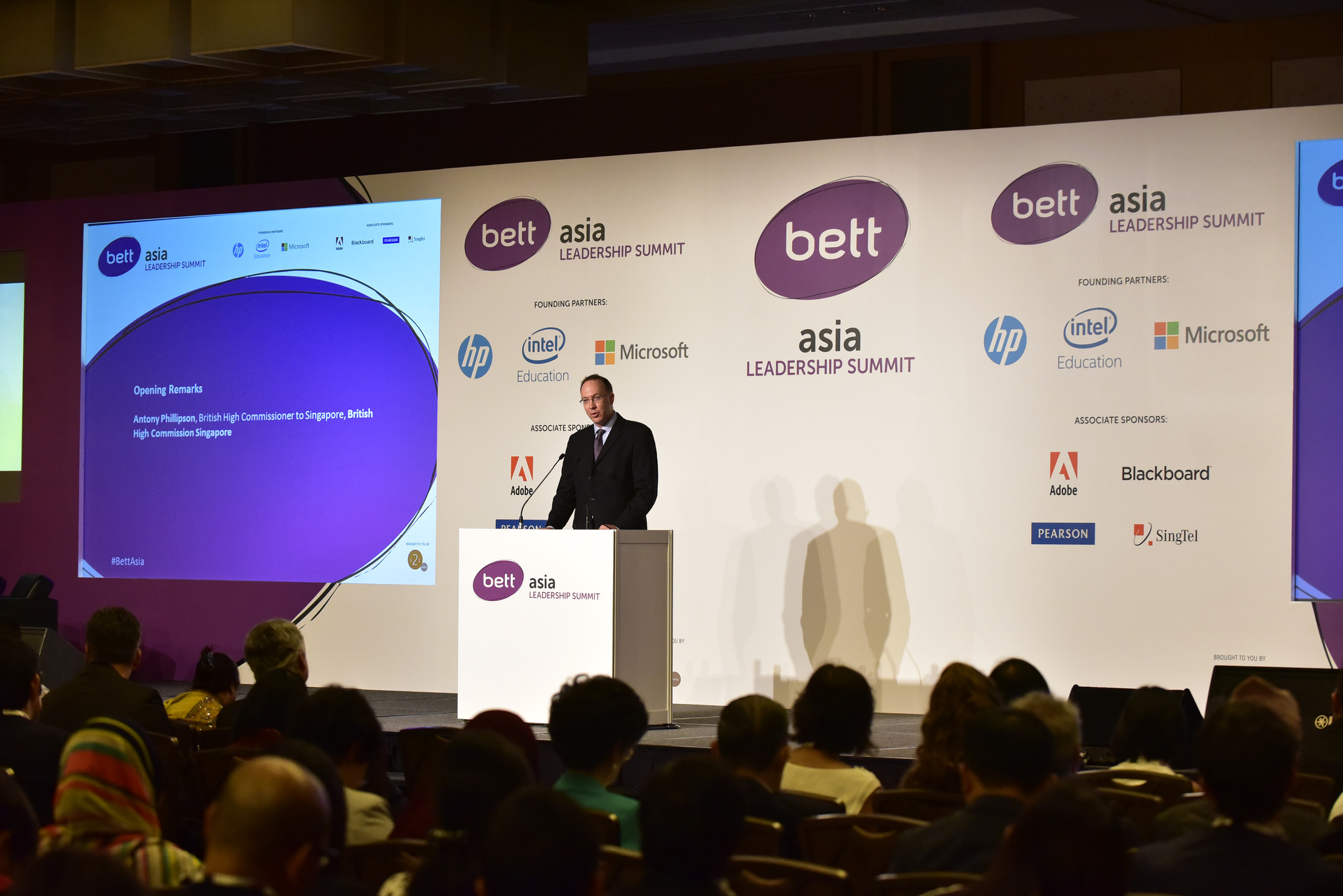
Bett has been the global meeting place for the education technology community, as seen by many of its world-class events. This time, Bett has brought its mission to promote the discovery of technology and knowledge to enhance lifelong learning, to Singapore - Asia’s meeting place for education decision makers. Nonetheless, it was exciting to see some big names up there such as Intel, Microsoft and Hewlett-Packard, who were dishing out their takes on how technology can be used, adapted and even innovated to better help the learners of today and the future. Along them, many other technology companies and organisations were also putting their take into the mindshare that is technology-aided education. [caption id=“attachment_18933” align=“aligncenter” width=“2048”] Microsoft asks conference attendees to write down: What’s The Future of Education To You?[/caption] Many quotes were passed around, including bold statements such as: ...

Learning Javascript API for Office

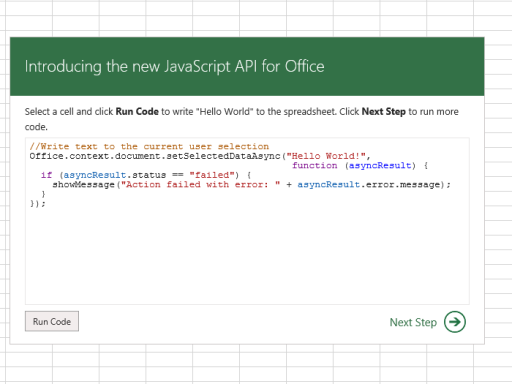
Did you know you could build apps for Office? Microsoft already created a JavaScript API tutorial for Office in the form of an app, a long while ago. Really, what the app teaches you are the basic development tasks by letting you interactively run and edit JavaScript code directly in Microsoft Excel! You can start running the tutorial online, but make sure that you’re running at least Internet Explorer 9, Safari 5.0.6, Firefox 5, Chrome 13, or a later version of one of these browsers. If not, you can also download a Windows App version of the tutorial, that will run Microsoft Excel directly, from the Windows Store. [caption id=“attachment_18920” align=“aligncenter” width=“640”] Javascript API Napa Tutorial[/caption] Now when we mean basic, the tutorial itself covers: reading and writing text, ranges, tables (including updating data in a table), getting and setting coordinates, and most importantly, making persistent settings. As a bonus, the app allows online access to all tutorials using the “Napa” Office 365 Development Tools too. Also if you didn’t know, because the API Tutorial app references the jQuery library (version 1.7.1), you can also use jQuery in your script! When you run the app from the Excel Web App (and because script is running in the context of the browser you opened it with), most JavaScript supported by that browser should run as well. Neat, huh? If you want a total walkthrough on learning the Javascript API tutorial, you can find out more on the Microsoft Apps for Office and SharePoint blog.

Intel's Future Showcase

Today’s inventions and innovations can change the world of tomorrow, and Intel’s no stranger to that ideal. Having significantly contributed to these changes through their own innovation and research in various areas of technology, Intel’s labs and research locations around the globe have been their driving force. This brings us to the Intel Future Showcase exhibition, which made its way to Singapore last Friday. Partners, influencers and media were given the opportunity to embark on a once-in-a-lifetime journey into the future. Having been exposed to the interesting insights into the technologies of today, it’s been breathtaking to first-handily experience the technology that will change how we live, work and play in the land of tomorrow. [caption id=“attachment_18910” align=“aligncenter” width=“1368”] Intel’s Concepts of The Future, being demonstrated to partners and media alike.[/caption] Starting with “Today”, Intel showcases its fodder of typical tablets powered by their technology, and more interestingly, their take on devices meant for education. These tables are lightweight, made of kid-proof tough plastic (though honestly, kids will find a way) and bundled with a myriad of other built-in peripherals - this including, a back-facing camera with the ability to turn into a fairly sharp microscope, via the attachment of a purposefully made, cheap plastic lens. The essential factor that Intel is playing here, is that the price tag on many of these devices, make them highly accessible for people to pick up. [caption id=“attachment_18909” align=“aligncenter” width=“1368”] Here, Intel Engineers show off some of Intel’s line of tablets for consumers.[/caption] We then move to “Tomorrow”, where we see Intel’s acquisition of Basis Science, come to light with their strategy to shoot into the wearables market by learning how people would interact with the technology, and how well onboard sensors do. Other than the typical pulse, gyroscope and pedometer sensors, additional sensors that check sweat and temperature have also been included, definitely being an ode to Intel’s thirst for gathering data to find better ways to analyze them. Alongside it, Intel RealSense was another notable showcase on its own, where normal built-in camera hardware for laptops and tablets, have been revolutionised to understand depth to become 3D scanners and on-the-fly, gesture-controlled MIDI interpreters. [caption id=“attachment_18908” align=“aligncenter” width=“1368”] Here, an Intel Engineer is explaining the concepts behind this Maker Project.[/caption] Finally, we enter the “Future”, where Intel puts its focus on an interactive environment, where Intel Engineers explain the assortment of physically hacked together contraptions and maker projects. One engineer explains the concept behind a curiously shaped food-net, that has been converted into a proximity musical synthesizer, producing music based on the distance of a group of five’s hands from a series of ultrasonic sensors. Another explains the genius behind a color-sensitive, imaging sensor with potential applications to help the colorblind and construction workers through the color zones. Behind all of these amazing maker projects, is the Intel Galileo development board - the computational brain powering them. [caption id=“attachment_18907” align=“aligncenter” width=“1368”] A picture of an Intel Galileo Board on display, at the Intel Future Showcase.[/caption] The highlights of the showcase culminate in a fully-built smart-city, smart-car demonstration, where Intel tells its story of how the Internet-of-things and smart technology can be put into the dashboard of a smart car, to give a new perspective on car sharing, personal recommendations, emotional sensing and dynamic environmental awareness. Wireless technologies too have never been better, with Intel demoing its wireless charging principles and prototype technologies in a world, where electricity is as free-moving as information itself. What a world to be living in where all you need to do, is look inside.

Imagine Cup Singapore 2015

Microsoft’s premier student technology competition, Imagine Cup, returns for its 13th year with three big competitions: Games, Innovation and World Citizenship. You could win a trip to compete in Seattle, Washington, U.S.A., the home of Microsoft for the coveted Imagine Cup trophy and $50,000. Imagine Cup Timeline: 29 October 2014: Pitch Video 3 December 2014: Online Blueprint 7 January 2014: User Experience Challenge April 2015: Singapore Finals Get your team together, learn about the competitions, and write out your proposal (sample attached), and email us at chunsiong.tan(AT)microsoft(DOT)com! ...