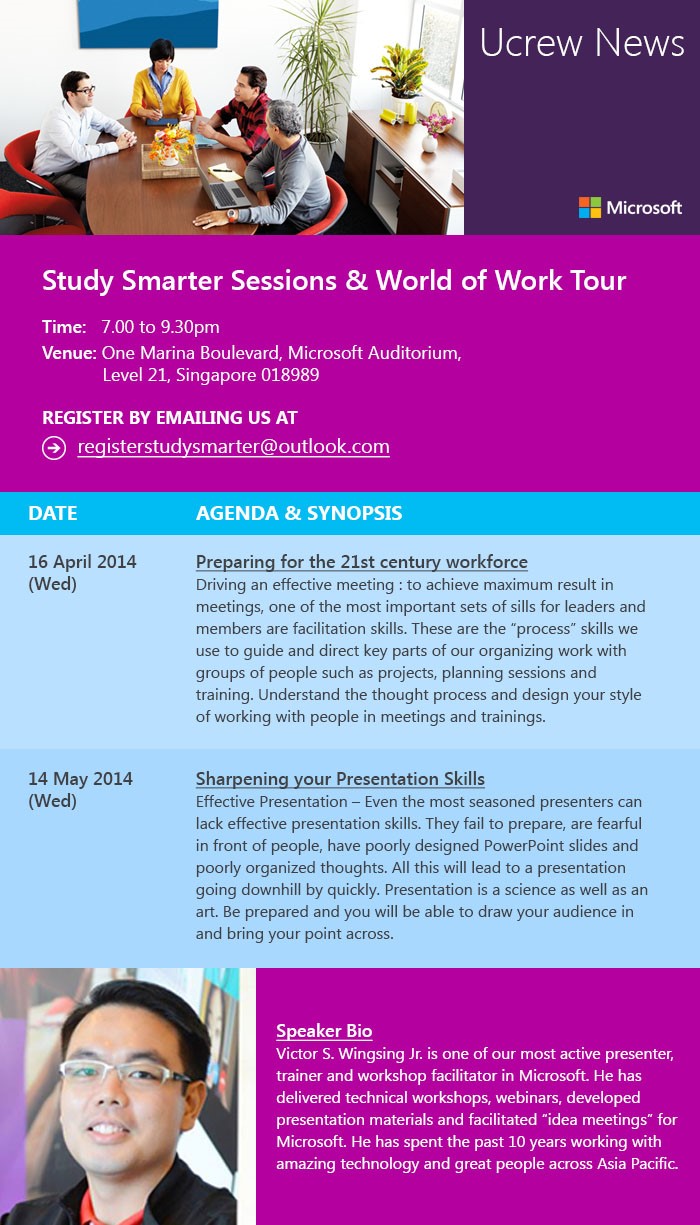
Students: Study Smarter Sessions & World of Work Tour
Add to Calendar: http://bit.ly/ucrewlive Livestream: http://bit.ly/ucrewlive1004

[caption id=“attachment_17585” align=“alignnone” width=“610”] Ada Lovelace, world’s first computer programmer.[/caption] Despite growing sentiment of females becoming increasingly represented in the technology industry, I’ve come to realize that few are engineers themselves. In contrast, Bill Gates, Mark Zuckerberg, Larry Page, Jeff Bezos, and just about every other male tech leader started by writing code. Singapore loves technology. We have the world’s highest smartphone penetration rate, and rank among the highest for internet usage. Of the top 20 companies on jobseekers’ wishlist, half belong in the technology industry. In terms of gender, reports show women love their gadgets and use technology as much (or more if we’re talking social media) as men. ...
After a long round of judging for the semi-finalist today, we are happy to share with you the top teams who will be moving forward to the finalist round. The finalist team are Team STAND Team AVID TMT Elites Team Nexi Team Life Choices Syncholima We will be posting for information on the Finals soon :)
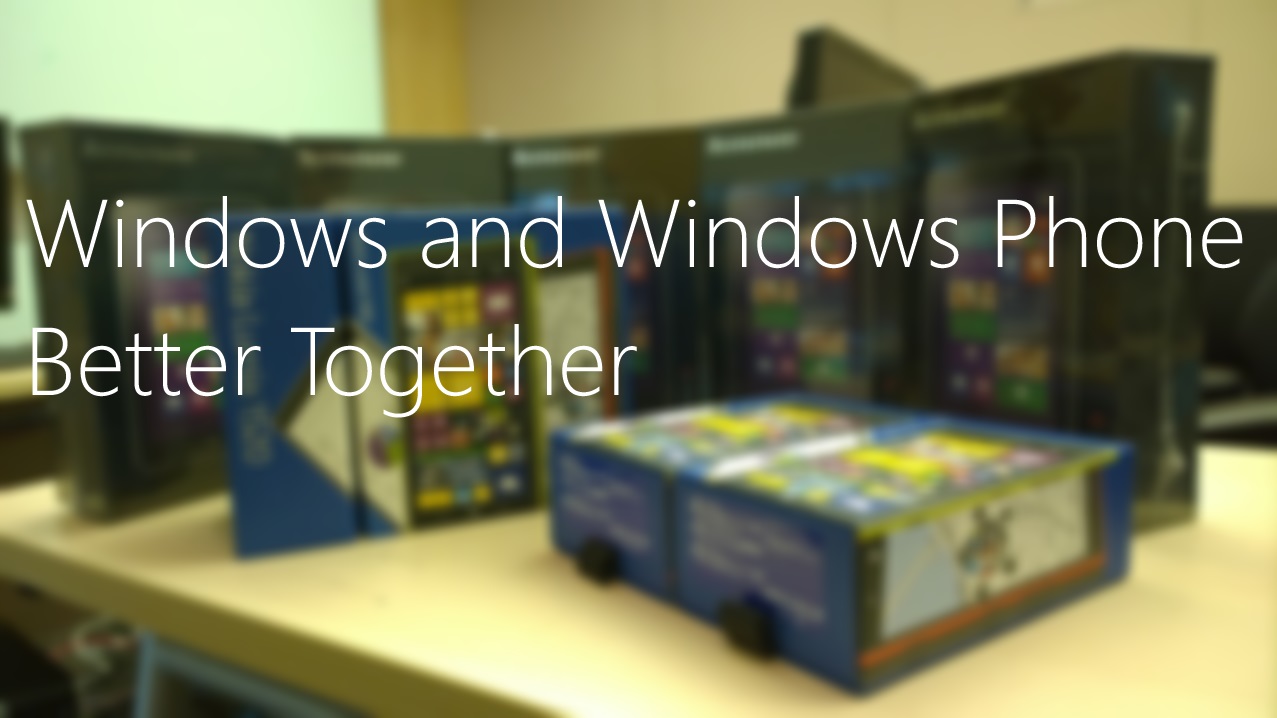
Hi Students of Singapore! We have a new challenge specifically targeting Singapore Students from now until 30th April 2014! The “Better Together” contest is a local finals to the Windows and Windows Phone Challenge on www.imaginecup.com. We will have awarding to the Top 5 valid entries from Singapore of Imagine Cup Windows and Windows Phone Challenge 1 x Lenovo Miix8-2 Tablet 1 x Nokia Lumia 1520 Developer Device To participate in this competition, you would need to ...
In this Developer Feature series, Spiffy talks to up-and-coming developers to learn what makes them tick. For our first feature in 2014, we have 35-year-old Team Westeros, made up of computer engineers Du Lingyi, Huang Geng, Meng Kaizhi and Zheng Naijia. Together, they developed an a Windows Phone/Windows 8 app for NUS’ internal Integrated Virtual Learning Environment (IVLE). [caption id=“attachment_17079” align=“aligncenter” width=“640”] Team Westeros members: Huang Geng (Back row second-rightmost), Du Lingyi (Back row third-rightmost), Meng Kaizhi (Back row fourth-rightmost)[/caption] ...
Looking for a guide to get the OpenVPN Community Version on Azure? Follow the guide below. So first up, What do we need? 1. 30-Day Trial Azure Subscription [link] 2. A little bit of knowledge of Linux shell commands 3. PuTTY [link] 4. OpenVPN GUI [link] Right. Now that we’ve gone through the pre-requisites, let’s move on to the fun part. First up, we gotta head into Azure and create a virtual machine. Let’s quick create a machine as seen below. A shared core and 768MB of RAM is more than enough for just an OpenVPN server as the overhead isn’t too large. If you want to change the region to another region, go ahead but leave the rest as defaults. Note down the password you use and the username. Once you press the create button, give it a little bit for Azure to set-up everything and then proceed to the next step once you see it’s Status in Azure has been updated to “Running” with a green tick at the left. Now we have to configure some endpoints on the virtual machine itself as to make sure that your internet traffic is able to reach the virtual machine. Go to the Endpoints Tab in your Virtual Machine once it’s been created and hit the add button at the bottom. Both buttons have been highlighted in the image below. Once you select add, you will be presented with a small pop-up wizard. Configure it according to the two images below If it is done correctly, you should have an Endpoints tab looking like the one below. If all is good, it’s time to move on to configuring the virtual machine you just set-up! Now’s the time to fire up PuTTY that you downloaded just a moment ago. Fill up the relevant details in this format: username@dnsname Example: azureuser@spiffyrocks.cloudapp.net Hit Open to start connecting to the virtual machine. You will most likely get a warning like the one below but just hit yes. Next up you’ll have to key your password into the black box, don’t worry if you do not see your password being typed and just continue typing it and hit the Enter key when you’re done. You should be logged into your Azure Virtual machine now and should see something similar to the image below. Now, let’s proceed onto this by just typing commands into the box above. Each line means a new command. ...
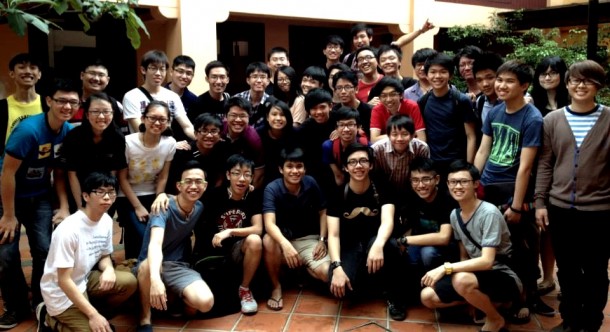
On 21st December, Microsoft Singapore celebrated Christmas with its family of Microsoft Student Partners (MSPs) by treating them to a good time at The Escape Artist. Together, the students put their wits and wiles to solve challenging puzzles in a thrilling environment. Big props to these awesome students for juggling both their academic and student ambassador commitments so well in the past semester! Who are the Microsoft Student Partners? Microsoft Student Partners are technology enthusiasts, trend-setters, and revolutionary thinkers. As MSPs, they act as ambassadors of Microsoft technologies and participate in frequent campus initiatives to demonstrate and train students in developing expertise for tools such as Visual Studio and MS Office. Some may mistaken them as geeks, but I prefer calling them passionate and inventive. Having met and spoken with a good number of them, I can assure that this is a network of fun-loving, bold-thinking and resourceful students regarded as technology leaders by their peers. Many of their alumni have gone places, building start-ups, representing in global competitions and landing jobs at big international names. Being also the inquisitive sort, the MSPs have monthly meet-ups hosted by Microsoft Singapore where they learn about technology, attend workshops, give presentations, and meet exciting people both within the industry and its surrounding ecosystem. Since the MSPs come from all sorts of backgrounds and institutions, every meeting further serves as a good opportunity for friendly catch-ups and relationship building. It is not uncommon for MSPs to support and even “impart new skills” to their peers from other institutions. Personally, I’ve been encouraged by their technical skills, excitement and zealousness. At a stage where I’m starting to find it increasingly difficult to pursue my dreams (read: family, bills, commitments, life…) it’s nice to be reminded by their passion to do great things with technology.
In this Developer Feature series, Spiffy talks to up-and-coming developers to learn what makes them tick. This is part 2 of our interview with 16-year-old Yan Zheng Hao, a first-year Game Design & Development student from ITE College Central (tertiary student) in Singapore. What is your app about and how did you come up with your idea? The first few apps published on the Windows Phone Store are admittedly quite gimmickly such as Metal Detector, & Nokia Lumia Ringtone as I’m still trying to get used to C# and Silverlight. Those 2 apps are perhaps my foundation to building better apps. A few months later with much support from the Nokia Developers community when Nokia embraced the Windows Phone platform. That is when my third app is released, with the hope of bringing xin MSN video (Localized version of MSN for Singapore market) to Windows Phone. As MSN video at that point of time only supports Flash and Silverlight, and neither one of them could be watched on Windows Phone. I used techniques such as HTML parsing to retrieve the data off the website since I do not have access to the APIs. http://www.windowsphone.com/en-sg/store/app/xin-videos/7c906b24-e928-47e0-a911-f682ed89f203 It was rather encouraging to see myself actually accomplishing it, something that I once thought it was impossible without the APIs. A Windows Phone exclusive app to watch xinmsn video, where Android and iOS couldn’t. – Something I can tell my friends, this thing is only on Windows Phone and do you have it on Android or iOS? Then came BUILD 2012 that got me excited. I knew Windows 8 it is going to be a huge ecosystem, and I really want to get into the market as soon as possible in terms of apps. That was when I started joining events hosted by Microsoft Singapore such as Hackathons, Talks, Workshops, & etc with much support from the team (Joyce Huang, Chun Siong, Yizhe Shen and many more) as the new WinRT APIs were really quite unfamiliar to me. Those events are rarely held by Apple and Google, Singapore is mostly neglected and I have never considered building apps for those platforms. The process & tools needed to building apps for the Windows platform is unmatched too! One of the app that was released a 3 weeks after Windows 8 was launched was MegaTube, which is a third party YouTube client for Windows 8. It is again something that I got the idea when I need to download a YouTube video for offline use, and many websites out there have enormously long delay (advertisements) before you get your video or requiring you to install software that cannot be run on the Windows RT platform such as Surface RT. I was rather reluctant to create a third party YouTube client at first, as this space was rather competitive with established players such asPrimeTube, YouTube+, MetroTube (Windows Phone), & YouTube Player. Starting out & focusing as a ‘downloader’ really gave me an entry to the market, gradually I improved the app to a full pledged YouTube experience. I was glad that I have made the right choice as it was well a success, with the app currently sitting on the top 100 free apps under the US store and over 1.4 million downloads to date. One key marketing strategy was AdDuplex that really propelled my app to the top since its release, with over 100 million impressions served and 200,000 users acquired all for free. Great deal, considering that there will be times where there is no ads available from Microsoft PubCenter. AdDuplex is a fall back to advertising. It proved that there is a market for Windows 8 even for individual developer like me that is not too saturated yet. What’s your process for designing the user journey? In terms of designing the user’s journey, I always start with my needs. As a Windows Phone & Windows 8 user, it is relatively easy to identify what the users are looking for. I typically ship just 1-2 weeks right after I got the idea of what I want to do next and it is gradually improved over time. App reviews are a crucial part to that improvements, often I spend more than 10 minutes each day reading it and iron out issues or the things that they demand. The other aspect of my process of designing the user’s journey is to be the user myself. I tend to constantly use the app that I make over and over again to look for flaws, and ways I can improve it even further. What’s next for you? I am always looking out for new opportunities, there are certainly emerging technologies and ecosystem that I’ll be willing to try out. For instance, the Xbox One that I’m looking forward to. With Windows NT kernel on board and probably some pressure from Apple TV, PS4 that Microsoft may one day open the platform for indi developers like me. Or perhaps the smart watch, glass, etc. At the moment, I’ll be writing more apps for Windows 8 and Windows Phone as and when there is a gap that needs to be filled. Such as#2InstaWithMassiveLove that I am currently developing. (A fully featured Instagram app for Windows Phone, as Facebook is reluctant to make one)
In this Developer Feature series, Spiffy talks to up-and-coming developers to learn what makes them tick. We talk with with 16-year-old Yan Zheng Hao, a first-year Game Design & Development student from ITE College Central (tertiary student) in Singapore. What is your background and how did you get here? My background in programming started with mainly on the assembly side. Admittedly I was quite a heavy gamer back then when I was 12 years old, its this fascination for the things you can’t do normally (‘hacking’) for the game that I’m playing which is MapleStory. Rather than how most people started in programming with a Hello World app, I got to learn techniques like memory editing with CheatEngine (http://cheatengine.org) to change the game’s instruction according to what I want. (Schools in Singapore don’t teach programming until the age of 16 as a tertiary student) This soon became my foundation for programming when the first MapleStory game emulator, ‘odinms’ was released and open sourced back on 2008. I immediately downloaded it and start playing around with the source file written in Java 6 and Javascript. Again, this fascination and even addiction to the game that got me into learning Java and JS in order to customize it to my needs. It took around 1-2 years of copy and pasting, or rather the term ’leeching’ before making a breakthrough as I get to learn more things over time gradually. Every single emulator that’s publicity released was made for the global version of the game, and as a player for ‘MapleSEA’. I wanted to make one that’s based on the local edition, and that just took a month to successfully update the files for it. I soon got quite a lot of attention from other developers in this field and a public server was even opened at one point in time with a partner that lasted for 2.5 years. We have gotten over 1200 concurrent players at some point in time at peak. I learned even more during this process as I was really the only developer to handle everything on the game play. Me and my partner is reluctant to trust anyone out there after the source code was leaked once. For instance, the switch to Linux CentOS to save cost on hosting fees instead the usual Windows Server 2003/2008, security issues (dealing with constant DDOS/DOS attack), server side programming, emulating techniques to keep the game up to date with the official ones, database management & etc. However it have to be shut down due to some issues in June 2012 that I am unable to disclose. I am just an average scorer during my secondary school life, but the internet changed my life completely. In Singapore where the mentality of our society are towards education exclusively for a good future, why can’t anyone strike it on their own? What motivated you to start building apps? The shutting down of the server also means losing a source of my only revenue stream. That is when I made the switch my focus to mobile apps instead. Being already a rather passionate Windows Phone user with a HTC Trophy 7 and with Silverlight/.NET language available for development(means I am able to use my current Java knowledge and apply it, given that both languages were quite similar). I have chosen Windows Phone 7 as the platform. On top of that, as an early adopter of Windows Phone (Bought right after its launch in Singapore) there were a lot of missing gaps in terms of application required by me everyday. It can also be annoying at times when there is a lot of peer pressure from my friends, when at that point of time the trend is towards iPhone 3GS and I’m considered to have a ’low end’ or rather inferior phone without apps. I wanted to change that, and build it for myself as a start. ...